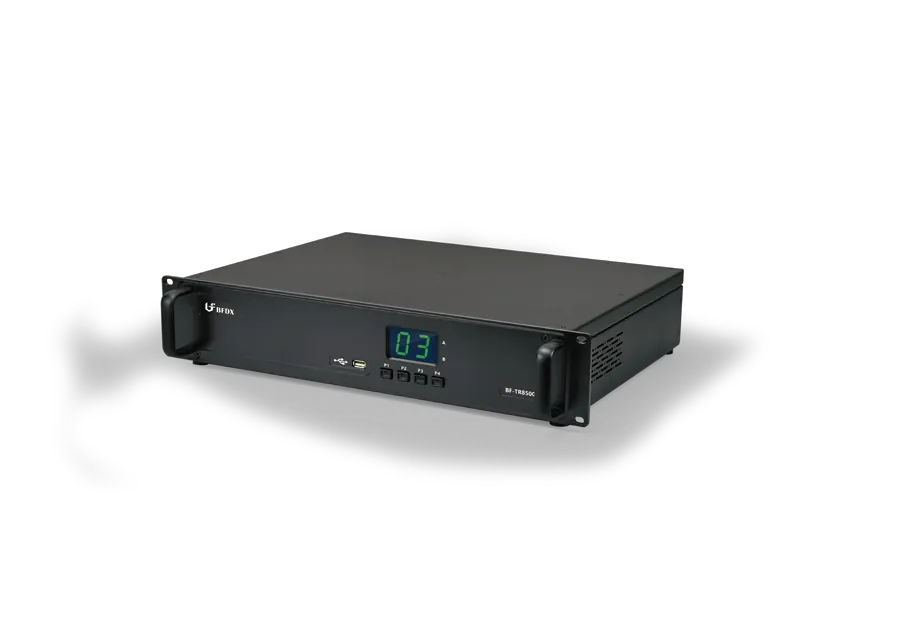
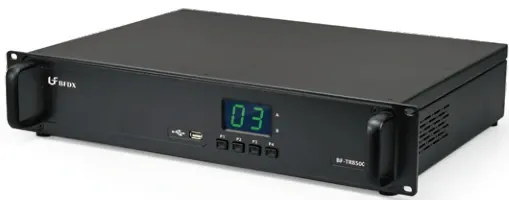
Digital Channel Unit BF-TR8500
19-inch 2U digital channel unit with 50 W output, built-in power and GPS/BDS positioning
A cost-effective digital channel unit in a standard 19-inch 2U rack chassis, with 50 W output, a built-in power module, emergency power float charging, active cooling, fault alarms and GPS/BDS positioning for fixed sites and regional coverage.
Reviewed by Ellen Zhou
- Mounting
- 19-inch 2U rack
- Output power
- 50 W
- Power
- Built-in module, emergency float charge
- Positioning
- GPS / BDS
Overview
The BF-TR8500 is a digital channel unit for fixed installations, built in a standard 19-inch 2U rack chassis. Its role is to provide the signal layer where a site needs dependable regional coverage and communication between zones, beyond what a handheld can reach.
Positioning and role
- Product type: digital channel unit for fixed installation.
- Mounting: standard 19-inch 2U rack chassis.
- Signal layer: dependable regional coverage and communication between zones.
- Typical sites: control buildings, plants, compounds and hill sites.
- Cost position: a cost-effective way to build the channel layer site by site.
System architecture
- Working modes: a broad set, so the same hardware covers today's requirement and later expansion rather than being replaced.
- Controller: an industrial-computer base station controller with multi-carrier channel sharing.
- Controller functions: protocol processing, network transmission management, device monitoring and voice call management.
- Data and expansion: data resource management plus the capacity expansion route for more channels.
- Dispatch platform: a browser-based B/S, all-IP application.
- Dispatch functions: voice and GIS dispatch, patrol management, positioning, historical queries, remote control and tiered permissions.
Power and cooling
- Built-in power: the power module sits inside the chassis, with no external supply in the cabinet.
- Float charge: a backup battery is kept charged and ready.
- Outage behaviour: on mains failure the channel unit continues from that battery.
- Design impact: the feature often decides the design for sites that are not staffed continuously.
- Active cooling: an active cooling unit handles continuous high-power operation.
- Clearance: keep the front and rear clear and away from hot exhaust from other equipment.
Satellite positioning and alarms
- GPS and BDS: satellite positioning is built in.
- Position reporting: the unit reports where it is deployed.
- Time reference: the same signal provides a time base for the network.
- Multi-site coordination: several sites can be identified and kept coordinated.
- Dispatch display: the platform can show the equipment's actual location.
- Fault alarms: equipment problems are reported to the network, so remote sites do not fail silently.
Coverage and installation
- Output power: 50 W for range in a fixed installation.
- Site count: higher power means fewer sites for the same area.
- Antenna position: a mast or rooftop antenna reaches far beyond a handheld.
- RF planning: the duplexer and antenna must suit the transmit and receive split.
- Feed and protection: feeder loss, connector quality, lightning protection and earthing all matter outdoors.
- Project scope: 2U rack space, mains and battery, antenna system, feeder and protection hardware, and an IP route.
Ordering
- Rack and power: confirm 2U of rack space with adequate depth and clearance, and decide on a backup battery.
- RF plan: confirm the duplexer and antenna for the transmit and receive frequencies.
- Backhaul: confirm the IP route back to the controller or platform, which also carries monitoring data and fault alarms.
- Dispatch integration: confirm whether connection to the dispatch management platform is required.
- Coverage: decide whether one unit covers the target area or several sites are needed.
- Licence and confirmation: licensing is usually per site, with channel and transmitter registered. We confirm configuration and frequency version before booking.
Full specification
| Product type | Digital channel unit for fixed installations |
|---|---|
| Mounting | Standard 19-inch 2U rack |
| Output power | 50 W |
| Power module | Built in |
| Backup power | Emergency power float-charge function |
| Cooling | Active cooling unit |
| Positioning | GPS / BDS satellite positioning |
| Monitoring | Fault alarm function |
| Working modes | Multiple modes for selection and upgrade |
| Deployment | Fixed installation, regional coverage and cross-zone communication |
| System integration | Base station controller and dispatch management platform |
| Controller functions | Business expansion, protocol processing, network transmission management, device monitoring, voice call management |
| Dispatch platform functions | Voice dispatch, GIS dispatch, patrol management, positioning, historical data query, remote control, tiered permissions |
Shipping & compliance
- Lithium battery: UN38.3 test summary and SDS are available for transport.
- Type approval, FCC or CE documents depend on the model and band version; confirm at quotation.
- Project pricing on request. MOQ and lead time depend on the model and configuration.
- Warranty and spare-parts terms are confirmed in the project quotation.
Typical applications
- Fixed sites that need regional coverage beyond handheld range
- Cross-zone communication between separate areas of one organisation
- Industrial plants and compounds with a control room
- Utility, transport and security networks built on a rack-mounted channel layer
- Systems that will be expanded channel by channel as traffic grows
- Sites reporting to a central dispatch and management platform
Frequently asked questions
Click a question to see the answer
What rack space and cabinet depth do we need?
The unit is a standard 19-inch 2U chassis. Confirm that the cabinet has the depth to take the body and still leave room at the rear for the feeder and power cabling, and that the airflow path at the front and rear of the chassis is not blocked by other equipment.
How does the emergency power arrangement work?
A power module is built into the chassis, and the unit provides a float-charge function so a backup battery stays charged and takes over automatically when mains power fails. Decide during planning whether the site needs that battery, because it affects the cabinet layout and the wiring.
What is the GPS / BDS positioning used for?
The built-in satellite positioning lets the unit report its position and provide a time reference, which helps identify and coordinate several sites in one network and lets the dispatch platform display where the equipment is installed.
Do we need a duplexer and which antenna?
A channel unit runs with either a single antenna through a duplexer or separate transmit and receive antennas with enough vertical separation. The choice follows from the transmit and receive frequency split, the antenna gain and the coverage target, so the duplexer and antenna are planned together with the site.
Can it be integrated with our dispatch platform?
The channel unit is designed to work with a base station controller and a dispatch management platform. Tell us which dispatch, recording or management functions the control room needs, and we will confirm the integration arrangement with the site design.
What decides how many units a project needs?
The coverage target, the terrain or building structure, the antenna position and height, the output power and the frequency plan together decide the number of sites. Send us the area to be covered and the channel plan and we will work through the layout with you.
Request a quote for this model
Send your required quantity, frequency band and target country — we will reply with pricing, lead time and shipping options.
Get a Quote