A single-site business typically needs 20–50 radios, 4–8 talk groups and one repeater.
Licence-free PMR446 or FRS handhelds stay at 0.5–2 W; a licensed business system usually uses 5 W handhelds with a repeater.
Analog suits simple coordination; DMR is the usual choice once departments need separate groups, radio IDs or encryption.
Plan the licence and coverage before ordering: the radio model follows the frequency assignment, not the other way round.
A business radio system is not a box of handhelds. It is a small network: a frequency plan, a repeater or base station, a talk-group structure and a fleet of radios that has to be charged, issued and replaced. Get those four right and the radio disappears into the operation. Get them wrong and the team goes back to shouting across the yard.
This page is for the buyer who has to make the system work across an office, a plant, a warehouse and a field team — often on one budget. It covers the configuration by role, the specifications that matter, the licence boundary and the questions to settle before you request a quotation.
Recommended configuration by role
Role / zone
Typical users
Recommended radio
Key features
Example quantity
Office & reception
4–8
Compact analog or DMR handheld
Discreet audio, earpiece, low alert volume
6
Warehouse / production
10–30
DMR handheld, IP67
Loud audio, long battery, gloved operation
24
Field & drivers
5–15
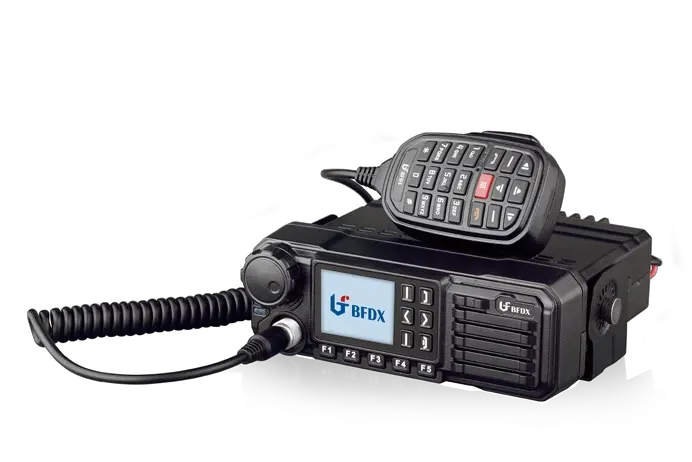
Mobile radio or PoC terminal
High power, roaming, GPS, vehicle charging
10
Security & gate
4–8
DMR handheld + base station
Emergency alarm, recording, dispatch
8
Management
2–4
DMR handheld
Priority group, cross-department calling
4
Example quantities for a 120-person site. Add 10–20% spares for shift work and repairs.
Equipment specification that matters
Item
Typical business specification
Why it matters
Frequency band
UHF 400–470 MHz or VHF 136–174 MHz
UHF works better indoors; VHF travels farther over open ground
Transmit power
4–5 W handheld; 25–50 W mobile
Licensed systems; licence-free handhelds are limited to 0.5–2 W
Channel capacity
32–1024 channels
Room for departments, zones and future growth
Protection
IP54 for office; IP67/IP68 for plant and yard
Dust, water and washdown resistance
Battery
12–18 h at a 5/5/90 duty cycle
Covers a full shift without a mid-shift charge
Encryption
Basic privacy to AES256
Protects commercial and personnel information
Analog vs DMR vs PoC for a business site
Dimension
Analog
DMR
PoC
Talk paths per 12.5 kHz
1
2 (TDMA)
Platform-dependent
Encryption
Voice inversion only
Basic privacy / AES256
Platform encryption
Coverage
Site + repeater
Site + repeater
Mobile network
Recurring cost
None per user
None per user
Subscription per user
Best fit
Simple coordination
Multi-department sites
Multi-site fleets
How many business radios do we need?
Start with the number of people who need to talk at the same time, not the total headcount. A 120-person site rarely needs 120 radios; 20–50 is more typical once shifts, shared positions and management are counted. A practical rule is 1.2–1.5 radios per active user, plus 10–20% spares for repairs and battery rotation.
Then add the fixed positions: reception, gate, control room, loading dock. These often need a base station or a vehicle set rather than another handheld, because the person is at a desk or in a cab for the whole shift.
Do business radios need a licence?
It depends on the band and the power. A business that stays inside PMR446, FRS or MURS can operate without an individual licence, but it cannot use a repeater or claim exclusive channels. A system with its own frequency, a rooftop antenna or 5 W handhelds needs an operator licence in the country of use.
The licence belongs to the company and the site, not to the radio. Type approval belongs to the model and band version. You normally need both, and they are separate processes.
Licence-free: 0.5 W PMR446 or 2 W FRS/MURS, handheld, shared channels.
Licensed: 4–5 W handhelds, repeater, fixed antenna, exclusive frequency.
Ask the supplier for the approval certificate that matches the exact model and band version.
Analog, DMR or PoC for a commercial site?
Analog is the lowest-cost choice when the requirement is simple coordination between a few groups. DMR becomes the better choice when several departments need their own talk groups, when radio IDs and recording matter, or when the site needs encryption. PoC is the better choice when the team is spread across cities or countries and building a radio network is impractical.
Most businesses end up with a mixed fleet: DMR on site, PoC for the road, and analog only where an old fleet still has to be supported.
How much does a business radio system cost?
The cost is not the price of one handheld multiplied by the headcount. It has four parts: radios and accessories, infrastructure (repeater, antennas, installation), licensing (application, coordination, term fees) and the operational cost of charging, programming and replacing the fleet.
Compare five-year totals, not sticker prices. A cheaper analog fleet can be the right answer for a small site; a DMR fleet that avoids a second frequency and supports recording can be cheaper over the term. Ask for a configuration with quantities, not a per-unit price list.
How do you manage a shared radio fleet?
A fleet without a routine fails quietly: batteries go flat, radios go missing, and the channel plan drifts. Use a charging rack per department, assign radios by number, and keep one master programming file. Label each radio with its group and position so a lost unit can be traced.
For shift-based operations, a simple sign-out sheet is enough. For larger sites, a radio management platform can push programming, track battery health and disable a lost terminal.
Can we mix legacy analog radios with a new DMR system?
Usually yes. Most DMR handhelds and repeaters support conventional analog mode, so the old fleet can stay on air while new departments move to digital. A digital call is not decoded by an analog radio and the reverse is also true, so mixed operation is planned channel by channel.
Decide which channels stay analog, which move to digital and when each department switches. A mixed fleet without a channel plan is two separate systems sharing a site.
What should be in a business radio quotation?
A usable quotation lists the radio model and band version, quantity by role, accessories, repeater and antenna scope, installation and commissioning, programming, licence support, warranty and lead time. It should also state the coverage test method and what happens if a defined area fails.
If a quotation has only a model and a unit price, it is not a system quotation yet. Ask for the missing items before comparing suppliers.
Local compliance and installation notes
Confirm the band, power and type approval for the destination country before the order is placed. A radio that is legal in one market may not be legal in another, and the licence is issued for a specific site and frequency.
Check the licence term and renewal date before the system goes live.
Keep the frequency assignment and the programming file together.
Confirm the recording policy and who may access call records.
For lithium batteries, keep UN38.3 and SDS documents for transport.
Agree the coverage acceptance method in writing before installation.
Project evidence
Multi-Building Industrial Park Network
Several production buildings, a warehouse and outdoor routes linked into one DMR network with a shared talk-group plan.
A supervisor can call any area from the control room; teams move between buildings without changing channel; the control room keeps a shift log.
Client name withheld; the figures describe the delivered configuration.
Plan for 12–20 radios for 30 active users, plus 10–20% spares. If several departments need separate groups, add a repeater and a DMR system rather than more handhelds.
Are these professional two way radios suitable for industrial sites?
Yes, with the right model and accessories. The same range covers professional two way radios for offices and an industrial two way radio system for plants, with IP-rated terminals, noise-cancelling audio and ATEX options where the zone requires them. For a mixed office and factory site, size the 2 way radio communication system around the noisiest and most remote area, not the office.
Do we need a licence for office use?
A small office using PMR446 or FRS handhelds may not need an individual licence, provided it stays inside the power and antenna limits. A multi-floor office with a repeater or fixed antenna normally needs a business licence.
Can we use PMR446 radios in a business?
In the UK and EU, PMR446 is available for business use within its limits. It is a shared band, cannot legally use a repeater in most countries, and is not suitable for a large or multi-floor site. See the licence-free guide for the exact limits.
What is the difference between business and commercial two-way radios?
The terms are usually interchangeable. The important differences are the band, power, channel capacity, protection rating and accessories, not the label. Compare the specification and the licence conditions for your site.
Can business radios connect to our phone system?
Yes, through a gateway or a repeater with SIP telephony. A radio user can reach an extension and a desk phone can call a radio. The integration scope is confirmed at design stage.
How long does a business radio installation take?
A single-site handheld deployment can be programmed and handed over in days. A repeater with antennas, cabling and a coverage test usually takes one to three weeks, depending on the building and approvals.
Can we add more radios or sites later?
Yes, if the channel plan and infrastructure are designed with growth in mind. Leave spare channels, choose a repeater with capacity and use a programming file that can be extended.
Get a project quotation
Send the site size, number of users and talk groups. Our engineers reply within one working day with a workable configuration.