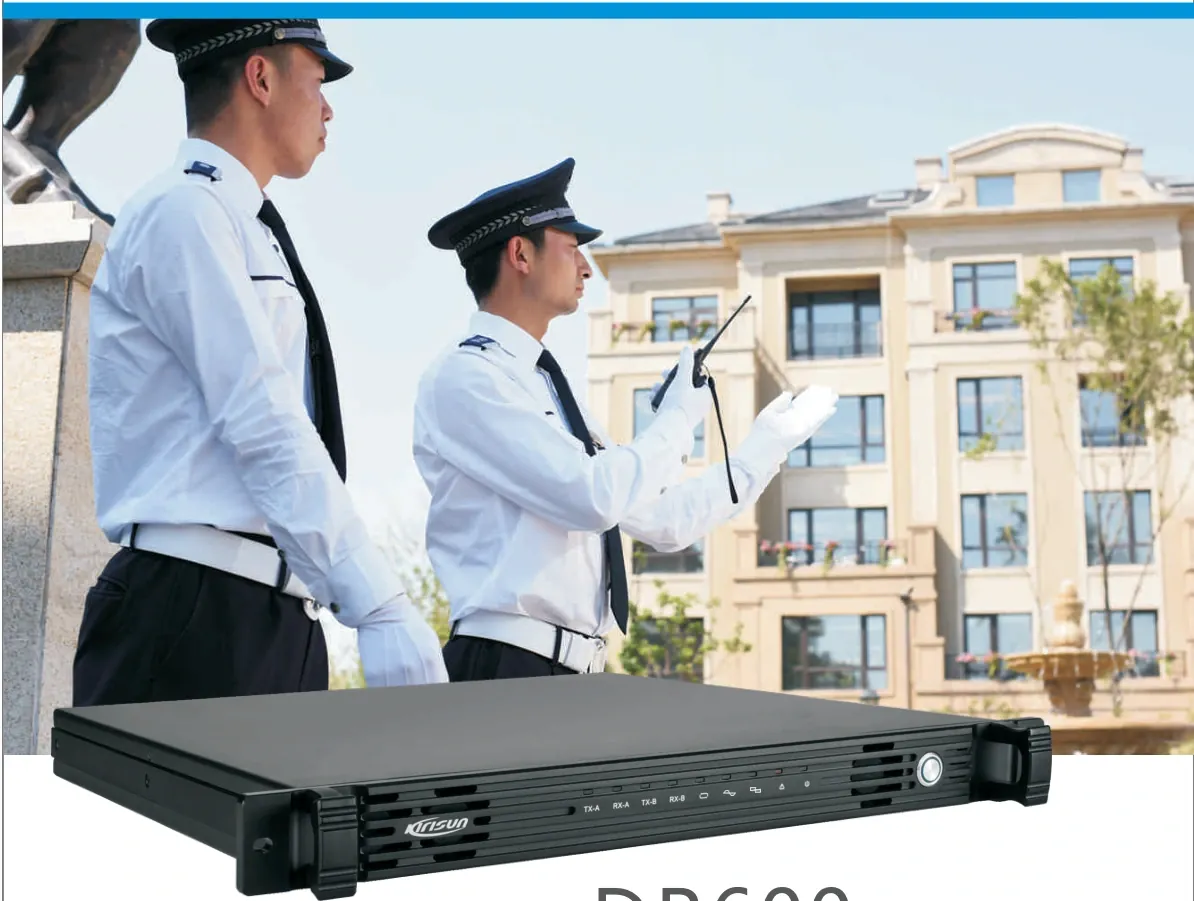
DMR/PDT Digital Repeater DR600
Standard DMR/PDT repeater with TDMA two-slot operation, 45 W VHF / 40 W UHF output and optional IP interconnection
A DMR/PDT compliant professional repeater with digital, analog and mixed modes, adaptive digital/analog forwarding, 64 channels, 45 W VHF and 40 W UHF output, DC or AC power, and open interfaces for third-party dispatch integration.
Reviewed by Ellen Zhou
- Standard
- DMR / PDT
- Output power
- 45 W (VHF) / 40 W (UHF)
- Channel capacity
- 64
- Working mode
- Digital / analog / mixed
Overview
The DR600 is a professional DMR/PDT digital repeater built to the standard protocols, with a simple front panel and a specification sheet written for system builders. Because it follows the standard air interface, it interoperates with other DMR/PDT terminals instead of tying a network to one equipment source.
Positioning and compatibility
- Standard protocols: built to the DMR/PDT standard air interface, not a private protocol.
- Open interoperability: it works with other DMR/PDT terminals.
- No single source: the network is not tied to one equipment supplier.
- Tender fit: standard compliance is usually the first question a tender asks.
- Simple front panel: controls are deliberately simple for system builders.
Modes and migration
- Three modes: digital, analog and mixed.
- Call detection: in mixed mode the repeater identifies whether a call is digital or analog.
- Adaptive forwarding: each call is forwarded in its own kind of signal.
- Own pace: analog radios keep working while digital units arrive in batches.
- Shared infrastructure: both user groups share the same infrastructure throughout the transition.
Capacity and channels
- TDMA two-slot: one carrier carries two simultaneous conversations.
- Spectrum: utilisation and user capacity double compared with a single-slot system.
- Hardware efficiency: digital mode gives two channels of talk from one set of equipment.
- Channel plan: 64 channels are planned against the number of talkgroups in use.
- Cost effect: covering a site takes less equipment.
Interfaces and services
- Interfaces: a 26-pin secondary development interface and an RJ45 Ethernet port.
- SIP dispatch: third-party dispatch integrates over SIP, so existing dispatch or recording platforms avoid a parallel system.
- IP interconnection: optional. When enabled, it links repeaters so sites behave as one wide-area network.
- Voice calls: individual call, group call and all call are forwarded.
- Data and control: short messages, call alert, stun, revive, kill, emergency alarm and emergency call are forwarded.
- Remote management: monitoring, diagnosis and control run over IP from a control room.
Receiver and installation
- Adjacent selectivity: 70 dB at 12.5 kHz and 75 dB at 20/25 kHz, by TIA603 and ETSI.
- Spurious and blocking: spurious response 75 dB by TIA603 and 70 dB by ETSI, with blocking at 90 dB.
- Conducted spurious: below -57 dBm under 1 GHz and below -47 dBm above 1 GHz.
- Audio quality: distortion under 3%, SNR -40 dB at 12.5 kHz and -45 dB at 20/25 kHz, response +1 to -3 dB.
- Practical effect: weak wanted signals stay separate from strong unwanted ones in crowded spectrum, deciding city-centre or industrial-plant coverage.
- Chassis: 44 x 482.6 x 450 mm, 11.2 kg, 1U chassis in a deep 19-inch rack. Check cabinet depth and cable clearance.
Ordering and power
- Power: DC 13.8 V plus or minus 20%, optional AC 100-250 V 50/60 Hz, or battery-backed DC.
- Current: under 15 A at 45 W, the figure for supply, fuse and cable sizing.
- Environment and output: -30 to +60 degrees Celsius, with 45 W on VHF and 40 W on UHF.
- Frequency range: 136-174 MHz, 400-470 MHz, 350-400 MHz or 450-520 MHz, matched to the licence.
- Channel plan and interfaces: 64 channels against talkgroups, with IP and dispatch options chosen up front, not added later.
- RF site plan: duplexer and antenna must suit the transmit and receive split and the coverage target.
Full specification
| Standard | DMR / PDT compliant, compatible with other DMR/PDT terminals |
|---|---|
| Frequency range | 136-174 MHz / 400-470 MHz / 350-400 MHz / 450-520 MHz |
| Channel capacity | 64 |
| Output power | 45 W (VHF) / 40 W (UHF) |
| Channel spacing | 12.5 kHz / 20 kHz / 25 kHz |
| Working voltage | DC 13.8 V ±20%; option AC 100-250 V, 50/60 Hz |
| Emission current | <15 A (45 W) |
| Dimensions (H x W x D) | 44 x 482.6 x 450 mm |
| Weight | 11.2 kg |
| Working temperature | -30 °C to +60 °C |
| Adjacent channel selectivity | TIA603: 70 dB @12.5 kHz / 75 dB @20/25 kHz; ETSI: 70 dB @12.5 kHz / 75 dB @20/25 kHz |
| Spurious response | TIA603: 75 dB; ETSI: 70 dB |
| Conducted spurious | -57 dBm below 1 GHz, -47 dBm above 1 GHz |
| Blocking | 90 dB |
| Receiving audio distortion | <3% |
| Signal to noise ratio | -40 dB @12.5 kHz, -45 dB @20/25 kHz |
| Receive audio response | +1 dB to -3 dB |
| Operating modes | Digital, analog and mixed with adaptive digital/analog forwarding |
| IP interconnection | Optional |
| Development interfaces | 26-pin interface and RJ45 Ethernet interface; SIP-based third-party dispatch support |
Shipping & compliance
- Lithium battery: UN38.3 test summary and SDS are available for transport.
- Type approval, FCC or CE documents depend on the model and band version; confirm at quotation.
- Project pricing on request. MOQ and lead time depend on the model and configuration.
- Warranty and spare-parts terms are confirmed in the project quotation.
Typical applications
- Professional digital radio systems that have to interoperate with other DMR/PDT terminals
- Multi-site networks linked over IP across a district or region
- Operations that run their own dispatch or recording platform and need open interfaces
- Industrial plants and complexes where adjacent channel interference is a daily reality
- Utilities, transport and security networks with a staged analog-to-digital migration
- Sites where voice and data services such as short messages and emergency calls have to be forwarded
Frequently asked questions
Click a question to see the answer
Is IP interconnection included?
IP interconnection is an option on this model. It has to be selected when the order is placed, because it changes how the network is built. Tell us whether sites will be linked and we will include it in the configuration.
Can we connect our own dispatch system?
Yes. The repeater provides a 26-pin secondary development interface and an RJ45 Ethernet interface, and third-party dispatch systems can be implemented over the SIP-based interface. Send us your dispatch or recording platform details and we will confirm the integration points.
Which power arrangement is right for us?
The repeater runs on DC 13.8 V with a plus or minus 20 percent tolerance, drawing under 15 A at 45 W, and an AC 100-250 V 50/60 Hz supply is available as an option. Sites that need battery backup run the DC input from a backed supply; sites that do not usually take the AC option for simplicity.
What should we check before installing it in a rack?
The chassis is 44 x 482.6 x 450 mm and weighs 11.2 kg. Check the cabinet depth for a 450 mm body, leave room at the rear for the feeder and DC cable, and allow airflow around the unit — and remember the antenna cannot be connected directly; a duplexer or a separate transmit and receive antenna arrangement is needed.
Will it work with our existing analog radios?
Yes. Mixed mode with adaptive digital/analog forwarding means the repeater recognises which kind of signal it receives and forwards it, so analog and digital users can share the site during a staged migration.
Which frequency range should we specify?
The model covers 136-174 MHz, 400-470 MHz, 350-400 MHz and 450-520 MHz. The right choice follows from the licence you hold in the destination market, so confirm the band with us before the order is placed.
Request a quote for this model
Send your required quantity, frequency band and target country — we will reply with pricing, lead time and shipping options.
Get a Quote