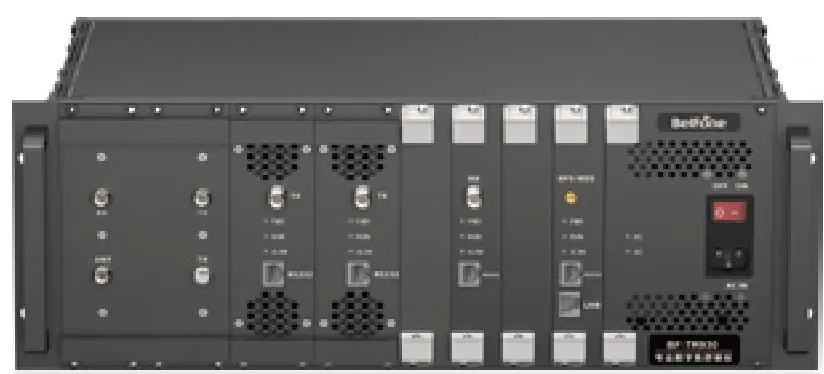
UHF Fixed Digital Trunking Base Station BF-TR930
Fixed UHF trunking base station — modular units, 19-inch 4U chassis, expansion to 4 carriers
A fixed-installation UHF digital trunking base station in a modular 19-inch 4U chassis. It manages and allocates the radio resources of the site, processes the dispatch services the network runs, and expands to four carriers inside one base station.
Reviewed by Ellen Zhou
- Type
- UHF fixed digital trunking base station
- Structure
- 19-inch 4U, unit-modular design
- Capacity
- Expandable to 4 carriers per base station
- Core function
- Resource management and dispatch services
Overview
The BF-TR930 is a UHF digital trunking base station for permanent, fixed installation. Unlike a conventional repeater that repeats a channel, it manages and allocates the radio resources of the site, processes the dispatch services the network runs, and expands in planned steps as the user base grows.
Positioning
- Type: UHF fixed digital trunking base station for permanent installations.
- Network role: the managed node at the centre of a site network.
- Resource control: manages and allocates the site's radio resources.
- Dispatch: processes the dispatch services the network depends on.
- Not a repeater: a conventional repeater repeats a channel; this base station directs a managed network.
- Network layer: completed by the base station controller and dispatch platform.
Capacity and channels
- Carriers: one base station expands to four carriers.
- Start small: begin with the carriers the first talk groups need.
- Traffic growth: more departments, talk groups or shift patterns share the network.
- Growth path: add carriers at the existing site, not a second site for the same area.
- Sizing: carrier quantity follows talk-group count and concurrent users.
- Design stage: the final quantity is fixed in site survey and traffic design.
System architecture
- Chassis: 19-inch 4U unit fits a standard equipment cabinet.
- Cabinet sharing: installs alongside power, transmission and monitoring equipment.
- Modular build: assembled from separate functional units, not one sealed block.
- Pay as you grow: configure for today's traffic and add capacity later.
- Serviceability: swap the affected unit in the cabinet instead of returning the base station.
Networking
- Single-site role: one base station covers one fixed site.
- In-site growth: carriers are added within the same base station.
- Site reuse: grows the existing site instead of building a duplicate.
- Network completion: the base station controller and dispatch platform complete the trunking network.
- System reference: the controller and platform layer are described under BF-9300/9500.
Installation
- Site survey: where the site sits, how high it can be built, cabinet or room space.
- Power and transmission: mains power with the required backup and links to dispatch or other sites.
- Customer scope: antenna, mast or tower, feeder, standard 19-inch cabinet or equipment room.
- Licensing: the user or local partner applies in the destination market; we supply the documentation.
- Coverage design: site height, terrain, antenna gain and band version set the coverage.
- No fixed distance: coverage is confirmed in the coverage design, not promised as a distance.
Ordering
- Configuration: carrier quantity, band version, talk groups and interface requirements.
- Per-project quote: the same model can differ completely between sites.
- No price list: the base station is quoted per project, not from fixed pricing.
- Band version: the UHF version is confirmed against the market and licence.
- Commercial terms: price, MOQ and lead time are confirmed in the project quotation.
Full specification
| Product type | Fixed digital trunking base station (UHF) |
|---|---|
| Frequency band | UHF; band version confirmed per market and licence |
| Chassis | 19-inch 4U, unit-modular construction |
| Installation | Fixed site installation in a standard 19-inch cabinet |
| Carrier capacity | Single base station expandable to 4 carriers |
| Resource management | Manages and allocates the radio resources of the site |
| Dispatch services | Processes the dispatch services required by the network |
| Expansion path | Carriers added at the existing base station as traffic grows |
| Coverage planning | Settled by site height, terrain, antenna gain and band version in the coverage design |
| Site preparation | Antenna, mast or tower, feeder, cabinet or equipment room, power and transmission provided by the customer or local partner |
| Licensing | Applied for by the user or local partner; technical documentation supplied by us |
| Commercial terms | Configuration and price quoted per project |
Shipping & compliance
- Lithium battery: UN38.3 test summary and SDS are available for transport.
- Type approval, FCC or CE documents depend on the model and band version; confirm at quotation.
- Project pricing on request. MOQ and lead time depend on the model and configuration.
- Warranty and spare-parts terms are confirmed in the project quotation.
Typical applications
- Public safety and emergency communications
- Government and enterprise private networks
- Police, security and patrol operations
- Industry, commerce and industrial campuses
- Utilities and infrastructure sites
- Command rooms and multi-site organisations
Frequently asked questions
Click a question to see the answer
What is the difference between this base station and a conventional repeater?
A conventional repeater repeats a channel. The BF-TR930 is a trunking base station: it manages and allocates the radio resources of the site, processes the dispatch services the network runs, uses a unit-modular design in a 19-inch 4U chassis, and can be expanded to 4 carriers inside the same base station as traffic grows.
How many carriers will our site need?
Carrier quantity follows the traffic — the number of talk groups, the number of users active at the same time and the dispatch services in use. A single BF-TR930 supports expansion to 4 carriers within one base station, so a site can start with the carriers it needs today; the final quantity is fixed during project design rather than quoted on this page.
Can the base station be expanded after it is installed?
Yes. A single base station supports expansion to 4 carriers, and the unit-modular design means capacity is added inside the existing base station, so the same site can grow instead of a second site being built for the same area.
What do we have to prepare on site?
A trunking deployment requires site survey, frequency licensing and civil works. The customer or local partner provides the antenna and mast or tower, the feeder run, a standard 19-inch cabinet or equipment room, mains power with the backup the operation requires, and the transmission link to the dispatch centre or to other sites. Frequency licensing is applied for by the user or the local partner in the destination market, and we supply the technical documentation the application needs.
Which band version should we order?
The BF-TR930 is a UHF base station. Band allocation differs by market, so tell us the destination country and the licence you hold, and we confirm the matching band version before the configuration is fixed.
How is the base station priced, and what about lead time?
Configuration is quoted per project. Carrier quantity, band version, talk groups, interfaces and the division of work on site all change what is delivered, so price, minimum order quantity and lead time are confirmed in the project quotation instead of being published as fixed figures.
Request a quote for this model
Send your required quantity, frequency band and target country — we will reply with pricing, lead time and shipping options.
Get a Quote