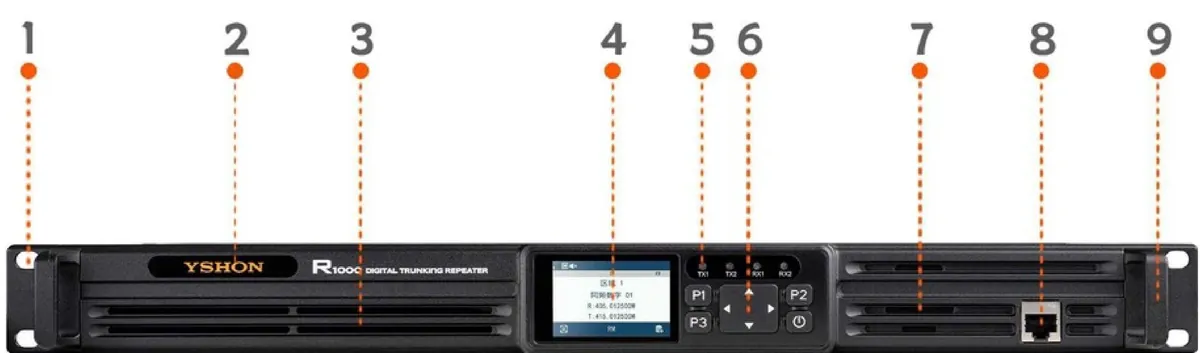
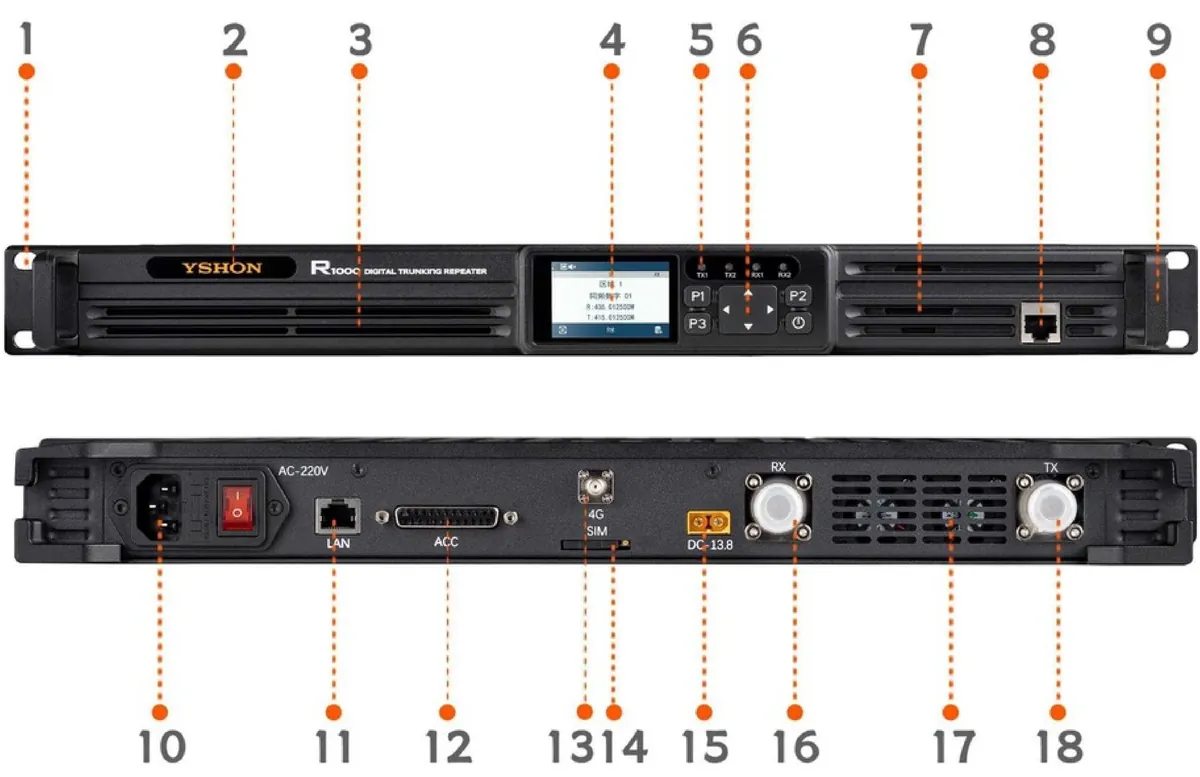
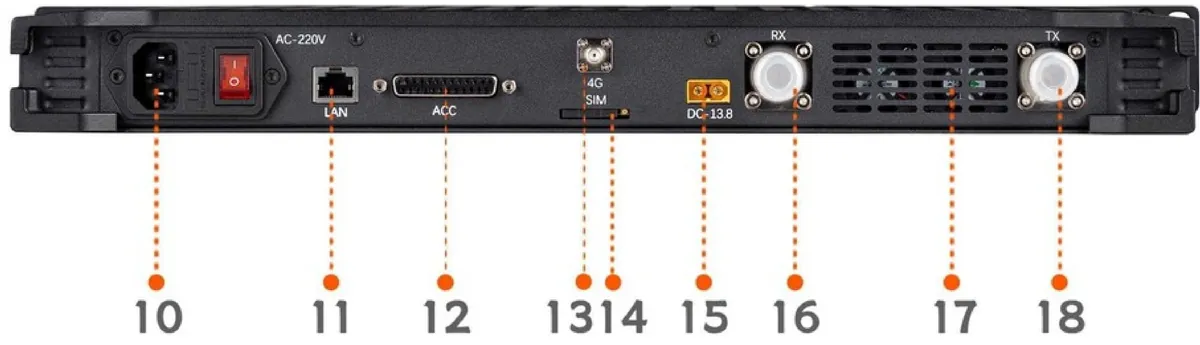
1U Multi-Mode Digital Repeater R2000
Ultra-thin 1U repeater with PDT / DMR / NXDN / analog modes and 5-50 W output
A 1U multi-mode repeater that carries PDT, DMR, NXDN and analog traffic on one chassis, with 5-50 W adjustable output and IP interconnection for wide-area voice and data networks.
Reviewed by Ellen Zhou
- Modes
- PDT / DMR / NXDN / Analog
- Output power
- 5-50 W
- Form factor
- 1U rack
- Networking
- IP interconnection
Overview
The R2000 is a 1U multi-mode professional digital repeater in the 2000 series, built so a single rack unit can carry a whole site. It combines an ultra-thin enclosure with wide coverage, long transmission distance, high reliability and room to expand.
Positioning and rack footprint
- Generation: 2000 series hardware with an updated exterior, reworked internal structure and stronger performance.
- Rack density: one 1U unit does the work of a much taller conventional repeater.
- Stacking: several units fit in the space one conventional repeater occupied.
- Height: the chassis is less than half the height of a conventional repeater.
- Integration: it saves cabinet space and fits into an existing communications system.
- Scaling: coverage grows unit by unit, with fewer cabinets and shorter rack cabling.
Modes and migration
- Four modes: PDT, DMR, NXDN and analog on one chassis.
- Mixed fleet: one repeater can carry terminals that are not yet uniform.
- Phased migration: analog handsets stay on air while digital units arrive in batches.
- Spectrum efficiency: advanced signal processing raises utilisation without a hard cut-over.
- Tender flexibility: the repeater purchase does not lock in the protocol decision.
Coverage and RF
- RF design: a new-generation radio stage with high sensitivity and high noise suppression.
- Vocoder correction: digital error correction keeps speech intelligible.
- Noisy sites: clear audio in loading bays, plant rooms and machine halls, where analog degrades first.
- Output range: 5 W to 50 W, adjustable.
- Low power: suits short-range in-building coverage and tight frequency reuse across sites.
- High power: gives a single site a wider footprint.
Networking
- IP interconnection: repeaters link over IP for wide-area voice and data.
- Wide and narrow: protocol-layer interworking between broadband and narrowband.
- Converged terminals: PoC terminals, smartphone apps and narrowband radios share one conversation path.
- Multi-site network: repeaters of the series link into a larger network.
- Uniform coverage: planned floor by floor, building by building or region by region.
Installation and power
- Airflow: leave the front and rear clear for the cooling path.
- Power feed: size it for continuous transmit duty, not standby.
- RF plumbing: the duplexer and antenna system must match the transmit and receive split.
- IP backhaul: add a network path when sites are to be linked.
Ordering
- Modes: confirm whether the fleet uses PDT, DMR, NXDN, analog or a mixture.
- Band and modes: confirm what the destination market authorises. We verify band and mode availability before booking.
- Antenna scheme: one antenna with a duplexer, or separately spaced transmit and receive antennas.
- Networking: IP-linked sites, or wide/narrow interworking towards PoC and smartphone users.
- Bill of materials: channel plan, antenna gain, feeder loss and dispatch arrangement follow from those answers.
- Licence: a repeater transmits on a licensed channel, usually included in the user's licence and handled locally.
Full specification
| Communication modes | PDT / DMR / NXDN / analog |
|---|---|
| Output power | 5-50 W, adjustable |
| Form factor | 1U rack, under half the height of a conventional repeater |
| IP interconnection | Supported — voice and data over wide areas |
| Wide / narrow interworking | Protocol-layer interworking between broadband and narrowband |
| Converged terminals | PoC terminals, smartphone app and narrowband terminals |
| Repeater networking | Can be linked with other repeaters of the series |
| RF design | High sensitivity with high noise suppression |
| Voice processing | Vocoder digital error correction |
| Spectrum efficiency | Improved by advanced signal processing |
| Migration path | Analog to digital upgrade without replacing the fleet at once |
Shipping & compliance
- Lithium battery: UN38.3 test summary and SDS are available for transport.
- Type approval, FCC or CE documents depend on the model and band version; confirm at quotation.
- Project pricing on request. MOQ and lead time depend on the model and configuration.
- Warranty and spare-parts terms are confirmed in the project quotation.
Typical applications
- Multi-floor buildings and campuses needing uniform coverage on one channel
- Wide-area networks linked between sites over IP
- Sites running analog and digital terminals side by side during migration
- Operations that need PoC and smartphone users on the same talk path as narrowband radios
- System integrators building coverage where rack space is the constraint
- Installations that have to grow carrier by carrier instead of being replaced
Frequently asked questions
Click a question to see the answer
Which modes should I specify for my fleet?
Tell us which terminals are in use today and which ones are planned. The R2000 covers PDT, DMR, NXDN and analog, so the same repeater can serve a mixed fleet; we confirm the mode set and the matching band version before the order is placed.
Can one repeater cover a whole building?
That depends on building structure, output power, antenna position and the radios in use, not on the repeater alone. As a rule of thumb, lower power covers a floor or a hall well, while higher power plus a well-placed antenna covers more; for deep indoor coverage we normally plan the antenna system first and the repeater second.
Do I need a duplexer and which antenna?
A repeater normally runs either a single antenna through a duplexer or separate transmit and receive antennas with enough vertical separation. Which one you need follows from the transmit and receive frequency split, the antenna gain and the coverage target, so the duplexer and antenna are specified together with the repeater.
How does IP interconnection work in practice?
Repeaters in different locations connect through their IP ports so the sites behave as one network for voice and data. That requires a network path between the sites — wired where available, or a wireless backhaul where cabling is impractical. Whether the path is available on site is the first thing to check.
Do we need a licence to operate it?
In most countries transmitting on a repeater channel requires a licence held by the user, and the repeater itself normally has to be registered in that licence. Licensing is handled locally by the importer or the operator; we provide the technical documentation needed for the application.
What should we decide before ordering?
Four things: the modes and band version for the destination market, the antenna and duplexer plan for the site, the channel and capacity plan, and whether the system needs IP-linked sites or converged communication with PoC and smartphone users. Confirm those and we will configure the rest with you.
Request a quote for this model
Send your required quantity, frequency band and target country — we will reply with pricing, lead time and shipping options.
Get a Quote