PDT Digital Repeater HR1060
Ultra-thin 1U PDT repeater with built-in power supply, integrated routing and SIP telephony gateway
A 1U PDT digital repeater with the power adapter built in, automatic DC/AC power switching, IP interconnection and integrated routing plus SIP telephony gateway — so dispatch consoles, SIP phones and VoIP applications join the radio network without extra gateway hardware.
Reviewed by Ellen Zhou
- Standard
- PDT digital
- Form factor
- 1U, built-in power adapter
- Power input
- DC + AC, automatic switching
- Gateway
- Integrated routing and SIP telephony gateway
Overview
The HR1060 is a PDT digital repeater designed to make a radio network cheaper to build and easier to run. Its brief was to strengthen repeater capability while simplifying configuration and maintenance.
Positioning and form factor
- Design goal: a radio network that costs less to build and is simpler to operate.
- Chassis: 1U, about half the height of a conventional repeater.
- New body: updated exterior, more compact housing and a faster processing core.
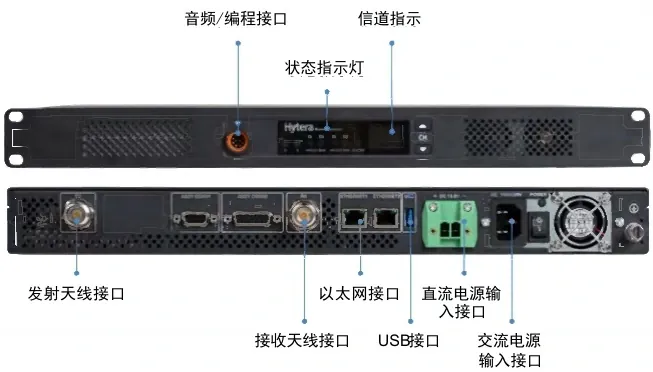
- Built-in power: the adapter sits inside the chassis, with no external supply to mount.
- Cabinet saving: no extra cable run, and rack space is freed for other equipment.
- Management layer: one platform replaces several separate boxes.
Power and processing
- Dual input: the unit accepts DC and AC and switches between them automatically.
- Backup behaviour: during a mains failure it runs from DC, then returns to AC unattended.
- Co-processor: data processing speed rises by up to 25 times.
- Combined load: the gain matters when signalling, gateway traffic and digital voice run together.
- Receiver: improved sensitivity gives greater distance and clearer voice on the same antenna system, especially at the coverage edge.
Integrated gateway
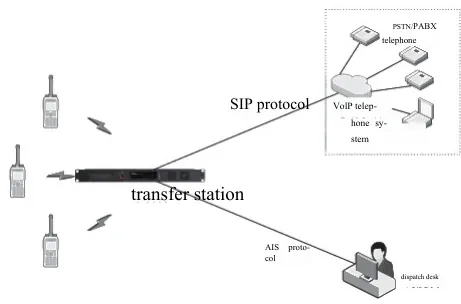
- Built-in routing: routing and telephone gateway are integrated in the repeater.
- Direct interfaces: it connects to dispatch consoles, SIP phones and VoIP applications.
- One conversation: radio users and phone users join the same call.
- Fewer boxes: no separate gateway purchase and a shorter equipment list.
- Lower cost: networking cost falls and one failure point is removed.
- Dispatch position: one dispatcher can reach radios and phones at once.
Networking
- IP linking: repeaters in different locations form one low-cost wide-area network.
- Two time slots: digital voice runs on two time slots through the accessory tail pin.
- Third-party access: the tail-pin interface is open for third-party extension.
- Wireless link: where no wired path exists, vehicle-mounted terminals establish a link so separate areas operate as one network.
- Typical sites: highway corridors, environmental monitoring, forest fire prevention and oil fields.
- Temporary work: emergency deployments where cabling costs too much or takes too long use the same wireless link.
Management and versions
- Web platform: configuration, monitoring and maintenance run from a browser.
- Centralised: the network is managed without visiting each unit.
- SNMP 3.0: network management communications are protected with data encryption.
- Mode switching: analog and digital channels switch automatically.
- Staged migration: one repeater carries both kinds of traffic during the transition.
- Versions: standard and enhanced versions cover single-site and multi-site networks without changing product lines.
Ordering
- Version: choose standard or enhanced against the feature list the network needs.
- Band and licence: confirm the frequency band and licence for the destination market.
- Power: decide whether a DC backup supply is part of the design.
- RF plan: settle the duplexer and antenna scheme for the site.
- Network path: IP where wired exists, wireless link where it does not.
- Dispatch: confirm console, SIP and VoIP arrangements so the gateway is configured to match.
Full specification
| Standard | PDT digital repeater |
|---|---|
| Form factor | 1U, about half the height of a conventional repeater |
| Power adapter | Built into the chassis |
| Power input | DC and AC input with automatic switching for backup |
| Processing | Co-processor, data processing speed up to 25 times faster |
| Receiver sensitivity | Enhanced, for greater communication distance |
| Working mode | Analog and digital channels, automatic switching |
| Time slots | 2 digital voice time slots through the accessory tail pin |
| IP interconnection | Repeaters in different locations linked over IP |
| Gateway functions | Integrated routing and telephone (SIP) gateway |
| Dispatch integration | Dispatch console, SIP phones and VoIP phone applications |
| Network management | Unified web-based platform, SNMP 3.0 with data encryption |
| Wireless link | Wireless link between repeaters via vehicle-mounted terminals |
| Versions | Standard version and enhanced version |
Shipping & compliance
- Lithium battery: UN38.3 test summary and SDS are available for transport.
- Type approval, FCC or CE documents depend on the model and band version; confirm at quotation.
- Project pricing on request. MOQ and lead time depend on the model and configuration.
- Warranty and spare-parts terms are confirmed in the project quotation.
Typical applications
- Wide-area networks covering several locations with or without wired backhaul
- Highway corridors and long transport routes
- Environmental monitoring and forest fire prevention networks
- Oil extraction fields and energy sites
- Temporary emergency deployments that cannot wait for cabled infrastructure
- Control rooms running dispatch consoles, SIP phones and VoIP applications
Frequently asked questions
Click a question to see the answer
Do we still need a separate telephone gateway?
No. The telephone gateway is integrated in the repeater, so compared with a conventional SIP telephone solution the project does not have to purchase a separate gateway, which is where part of the networking cost saving comes from.
Standard version or enhanced version?
Both are offered on this model. The choice depends on the feature set the network will actually use — number and type of sites, gateway and dispatch integration, and how much remote management is required. Send us the requirement list and we will confirm which version matches it.
How does the power backup work?
The unit accepts both DC and AC input and switches between them automatically. Running the repeater on the DC side with a battery or other DC backup keeps it on air during a mains failure and returns it to AC automatically afterwards.
Our sites have no wired network. Can they still be linked?
Yes, subject to the site arrangement. Where cables are impractical or too expensive, repeaters can be linked through a wireless link established by vehicle-mounted terminals, which is the approach used for highway corridors, environmental monitoring, forest fire prevention areas, oil sites and temporary emergency deployments.
Will it work with our dispatch and phone systems?
The repeater connects to dispatch consoles, SIP phones and VoIP applications directly through its integrated gateway, so radio users and phone users can be brought into the same conversation. Confirm your console and phone platform before ordering so the gateway is configured to match.
Do we need a licence and how many units?
A repeater channel normally has to be included in the user licence held for the market, so that is confirmed locally. The number of units follows from the coverage target, the terrain or building structure and the antenna plan — tell us the area to be covered and we will work through the layout with you.
Request a quote for this model
Send your required quantity, frequency band and target country — we will reply with pricing, lead time and shipping options.
Get a Quote