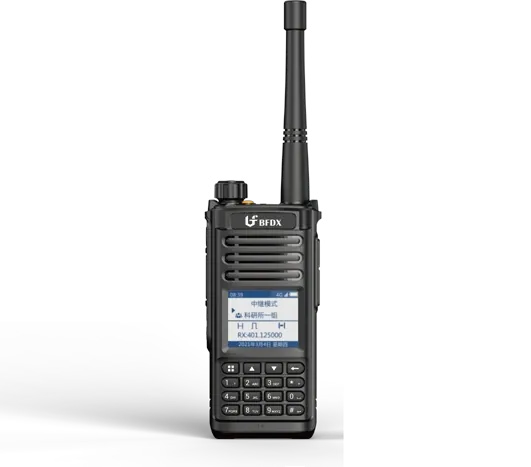
Dual-PTT Converged Radio BF-TP800
Independent public and private PTT keys: 4G full network plus a 400-480 MHz conventional module
A public-private converged handheld with separate PTT keys for each network, 4G full-network operation, a 400-480 MHz conventional module, a 1.8-inch semi-transmissive colour display, IP67 protection and a 5000 mAh removable battery.
Reviewed by Ellen Zhou
- Network
- 4G full network + 400-480 MHz conventional
- PTT keys
- Independent public and private PTT
- Protection
- IP67
- Battery
- 5000 mAh, removable
Overview
The BF-TP800 is a converged handheld built around two radios and two PTT keys: the public side and the private side each have their own key, so the user chooses the network with a thumb instead of a menu. A 4G full-network public side and a 400-480 MHz conventional module share one body, covering wide-area dispatch and an on-site licensed channel without carrying two devices.
Positioning
- Converged design: 4G full-network PTT and a 400-480 MHz conventional module in one terminal.
- Two PTT keys: independent public and private keys remove the menu step when time matters.
- Four modes: private network, public network, hybrid and repeater.
- No forced choice: if the 4G link is unavailable, the conventional side talks directly or through a repeater.
- Typical users: public safety, urban management, airports and rail operations, property management, logistics fleets and large industrial parks.
Network and SIM
- Public coverage: carrier-delivered 4G coverage reaches far more ground and needs no repeater of your own.
- Private coverage: the owner builds it with licensed frequencies, repeaters and sites.
- Dependency: the public side needs cellular signal, a SIM with a data plan and a platform subscription.
- Licensed band: 400-480 MHz is regulated in most markets and is not licence-free.
- Hybrid control: the operator decides which side each conversation should use.
- Platform: the public side is provisioned on the mainstream PoC platform you run.
Core functions
- Display: 1.8-inch semi-transmissive colour display, readable in daylight, with split-screen view.
- Keypad: a full keypad supports direct operation.
- Audio aids: voice announcement and low-battery prompts.
- Connectivity: Bluetooth and call recording.
- Positioning: GPS, BeiDou and GLONASS.
- Power: a 5000 mAh removable battery; a spare pack extends a long shift.
Dispatching
- Call types: single call, group call and all call cover everyday dispatch.
- Wide-area reach: the 4G side keeps a dispersed fleet in one talk group.
- Local channel: the conventional side keeps the site channel available.
- Escalation: a one-key emergency alarm raises an alert on the platform.
- Mode choice: hybrid operation assigns each conversation to the public or private side.
Durability
- IP67 protection: dust and water protection for field work.
- Battery continuity: the removable 5000 mAh pack is swapped, not charged, mid-shift.
- Daylight readability: the semi-transmissive display stays legible outdoors.
Ordering and OEM
- Licence: confirm you hold a local licence for the 400-480 MHz side; the band is regulated.
- Repeater: decide whether a repeater is needed for private-side site coverage.
- Platform and SIM: name the PoC platform and plan a 4G SIM with data for each unit.
- Mode mix: decide whether the fleet uses both modes or one is only a fallback, which sets the dual-PTT quantity.
- Band version: tell us the destination country and licence, and we confirm the band version and configuration.
- OEM: branding, packaging and quantity are confirmed in the same step.
Full specification
| Public network | 4G full network (multi-operator) |
|---|---|
| Conventional module | 400-480 MHz |
| Working modes | Private network / public network / hybrid / repeater |
| PTT | Independent public and private PTT keys |
| Display | 1.8-inch semi-transmissive colour display, split-screen view |
| Protection rating | IP67 |
| Battery | 5000 mAh, removable |
| Calling | Single call / group call / all call |
| Positioning | GPS / BeiDou / GLONASS |
| Data and audio | Bluetooth, call recording, full keypad |
| Alerts | One-key emergency alarm, voice announcement, low-battery prompt |
Shipping & compliance
- Lithium battery: UN38.3 test summary and SDS are available for transport.
- Type approval, FCC or CE documents depend on the model and band version; confirm at quotation.
- Project pricing on request. MOQ and lead time depend on the model and configuration.
- Warranty and spare-parts terms are confirmed in the project quotation.
- PoC device pricing excludes the data plan and platform subscription.
Typical applications
- Public safety and law enforcement
- Urban management and municipal field teams
- Airports and rail operations
- Property management and large campuses
- Logistics fleets and warehousing
- Large industrial parks
Frequently asked questions
Click a question to see the answer
What is the difference between a converged radio like this and a conventional DMR handheld?
A conventional DMR handheld works only on the licensed channels your own system provides. The BF-TP800 keeps that conventional module but adds 4G public network PTT, so the same handheld can reach a fleet across a city without repeaters and still fall back to the licensed channel where cellular coverage is weak.
Can it talk to our existing DMR fleet?
The private side is a 400-480 MHz conventional module, so the terminal can work on the conventional channels your fleet uses, provided you hold a licence for that band and the channel plan is shared. Send us the band and channel details and we will confirm before the order.
Do we need SIM cards and a data plan?
Yes, for the public network side. Each terminal needs a 4G SIM card and a data plan, and the fleet needs a subscription and dispatch account on your PoC platform. The private side does not use cellular data.
Do we need a radio licence for the 400-480 MHz side?
In most countries the 400-480 MHz band is regulated, so the conventional side requires a licence issued to the user and coordinated frequencies, usually arranged by the importer or the operating company locally. The 4G side relies on the carrier network instead.
Why do the two PTT keys matter?
They remove a menu decision from a time-critical moment. A dispatcher or field user presses the key for the network the message belongs to, and in hybrid mode can keep one ear on the site channel while the fleet channel stays available.
Can we buy it under our own brand?
OEM and ODM support is available. Send the logo files, packaging requirements and target quantity, and our team will confirm what can be customised on this model.
Request a quote for this model
Send your required quantity, frequency band and target country — we will reply with pricing, lead time and shipping options.
Get a Quote